San Diego’s year-round warmth means our garage floors face a problem that homeowners in colder climates only deal with seasonally: hot tire pickup. Tires absorb heat from asphalt that can exceed 130 degrees on sunny afternoons. That thermal energy transfers directly to the garage floor coating the moment you park.
As San Diego County’s exclusive certified Penntek installer, North County Synthetic Coatings sees this damage on epoxy floors across Oceanside, San Marcos, and Rancho Bernardo regularly. Here’s how to prevent it and what to do if it’s already happening.
What Is Hot Tire Pickup Exactly?
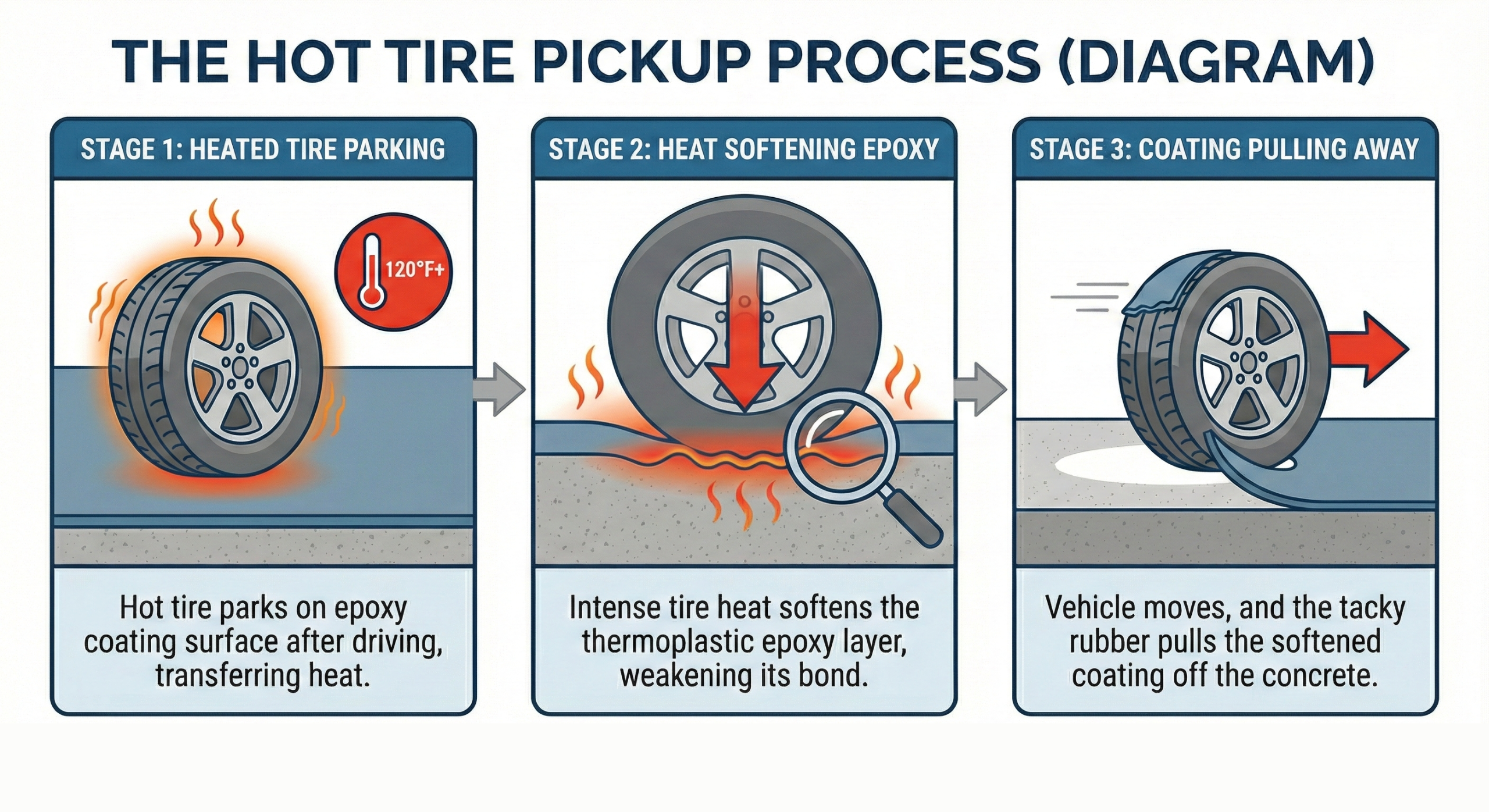
Hot tire pickup occurs when heated tires soften a garage floor coating, allowing the rubber to bond to the surface. When the tires cool and the vehicle moves again, the rubber pulls the softened coating off the concrete—sometimes in small patches, sometimes in long strips that follow the tire path.
The root cause is a property called thermoplasticity. Standard epoxy coatings are thermoplastic, meaning they soften when heated and re-harden when cooled. Lower-grade epoxy systems can begin to soften at temperatures commonly reached inside San Diego garages. Each heating and cooling cycle weakens the bond between coating and concrete a little more, until visible damage appears.
Why Are San Diego Garages Particularly Vulnerable?
In climates with cold winters, hot tire pickup only occurs during a few summer months. In San Diego County, the combination of year-round warmth, intense sun, and coastal humidity creates conditions that put standard epoxy under continuous thermal stress.
Daytime air temperatures routinely reach the 70s and 80s across communities like Carlsbad, Poway, and El Cajon, and asphalt surface temperatures run 40 to 60 degrees hotter than ambient air. That means tires rolling into a garage can carry surface temperatures well above 120 degrees even on a mild February afternoon.
The orientation of a garage can compound the issue. Many attached garages in North County face south or west, absorbing direct sun for hours, raising the slab temperature before a vehicle even enters. Coastal humidity from the morning marine layer can also weaken epoxy adhesion over time, making the coating more susceptible to tire pull when it heats up. The result is a floor that rarely gets a break from the conditions epoxy was never designed to handle continuously.
Choosing a Coating System That Resists Hot Tire Pickup

The most effective prevention for hot tire pickup is choosing a coating that doesn’t soften at the temperatures your garage floor reaches. Unlike epoxy, polyurea coatings are thermoset materials. Once cured, they maintain their structural integrity across a much wider temperature range. The molecular cross-linking in polyurea creates a rigid structure that won’t soften under hot tires.
The Penntek System
The Penntek industrial coatings system that North County Synthetic Coatings installs is specifically engineered to resist hot tire pickup:
- The polyurea base coat bonds to diamond-ground concrete and resists impact, abrasion, and thermal cycling.
- The polyaspartic topcoat adds chemical resistance and reduces the likelihood of tire adhesion even at elevated temperatures.
- The system is UV stable, so it resists yellowing or degradation under San Diego’s intense sun.
- Every installation comes with a limited lifetime warranty.
Surface Preparation
Equally important is the surface preparation underneath. Even a thermoset coating will fail if it’s applied over poorly prepped concrete. Industrial diamond grinding creates the mechanical bond profile that keeps the coating locked to the slab under repeated thermal stress.
Maintenance Tips for Your Current Garage Floor
If you have an existing epoxy floor that hasn’t started peeling yet, a few maintenance habits can slow the damage. However, they won’t change the fact that epoxy systems that weren’t formulated for high-heat environments may struggle in San Diego’s climate.
- Allow a few minutes after parking before walking on freshly heated areas of the coating.
- Keep the garage ventilated. Open a side door or window to reduce ambient temperature buildup.
- Clean the floor with pH-neutral cleaners rather than harsh chemicals that can further weaken the epoxy surface.
- Inspect the tire parking areas monthly for early signs of rubber marks, softening, or small patches where the coating appears to be lifting.
Once hot tire pickup progresses beyond minor surface marks into active peeling, maintenance won’t reverse the damage. At that point, the coating needs full removal, proper concrete profiling, and a thermoset polyurea system to permanently resolve the issue.
Choose a Coating Built for San Diego’s Climate
Hot tire pickup on an epoxy garage floor isn’t a maintenance failure. It’s a material limitation exposed by San Diego’s climate. The only lasting solution is a coating system engineered for continuous thermal cycling.
Contact North County Synthetic Coatings to learn about a garage floor coating engineered to resist lifting under hot tires.